Baumgasse 79, 1030 Wien, Austria
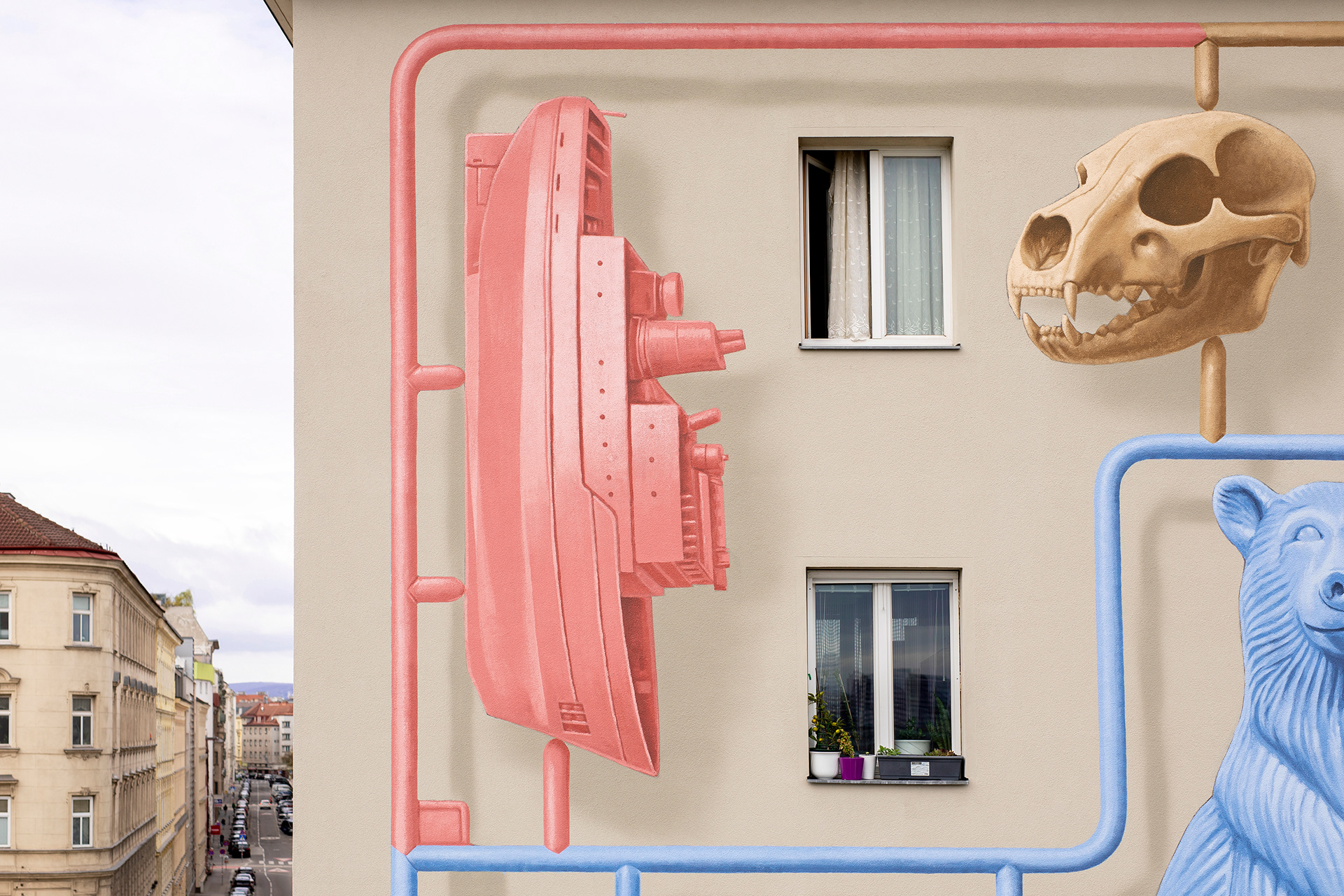
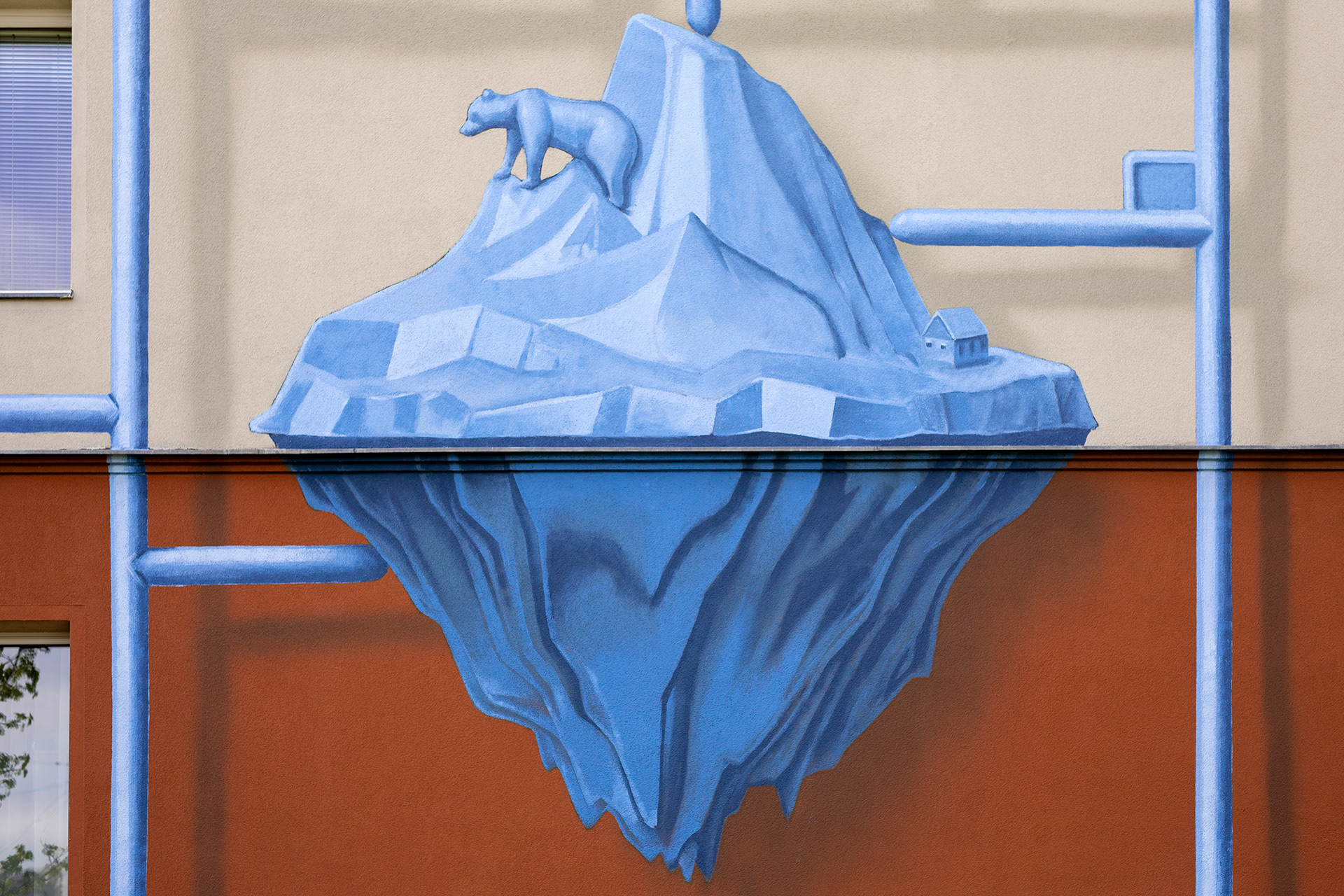
“Souvenir” was created within the framework of the Klima Biennale Wien, a project promoted by KunstHausWien, and curated by Calle Libre. Included in the “(No) Funny Games” program, the work is part of a broader reflection that uses apparent lightness and visual appeal as a device to critically address the social and environmental implications of the climate crisis.
In the artwork, the visual dimension unfolds through a layering of narratives that converge into a single conceptual tension. The natural environment appears transformed, filtered, made artificial: it is no longer a space experienced through relationship, but a distant construction, almost a simulation reflecting a perception of nature progressively emptied of empathy, in which the bond between human beings and ecosystems dissolves in favor of a controlled, utilitarian vision. Nature becomes something to observe, arrange, organize, as if it were a separate object rather than a system of which we are an integral part.
A dimension of only apparent lightness also emerges, linked to the gesture of play: an action that reduces complexity to surface, arranging elements without questioning consequences. Within this shift lies a reflection on the superficiality with which deep and irreversible processes are often approached. In this sense, play is not innocent; it becomes a metaphor for an operative mode that simplifies, abstracts and, in doing so, contributes to a loss of awareness.
The presence of industrial and synthetic materials, such as plastic, introduces a further layer of interpretation, directly linking human production to the transformation of ecosystems. It is not merely a formal element, but a concrete sign of the dynamics reshaping the natural landscape. In this context, the consequences of climate change do not appear as external or accidental events, but as direct outcomes of an altered system of relationships, in which human actions inevitably reflect upon the environment.
“Souvenir” thus takes shape as a kind of image-synthesis: a fragment that condenses the relationship between memory, perception and responsibility. It is something that is retained, preserved, but also reduced, simplified, turned into an object. Within this ambivalence lies a broader reflection on our ability to remember and understand what we are losing, and on the risk that this may also become the fate of real and urgent issues of the present.
Through an accessible yet layered visual language, the work invites a reading that unfolds over time, gradually revealing a tension between surface and depth. In this gap, between what appears and what it implies, a space of responsibility opens up: a place where the viewer is called not only to observe, but to recognize their own role within a fragile and interconnected balance.
ENG:
Title: “Souvenir"
Artist: NEVERCREW
Artist: NEVERCREW
Description: mural in Wien, Austria (2026)
Year: 2026
NEVERCREW is a Swiss contemporary artist duo (Christian Rebecchi and Pablo Togni) known for large-scale mural paintings, public art installations and site-specific artworks addressing environmental and social themes, including climate change, ecosystems and the relationship between humans and nature.
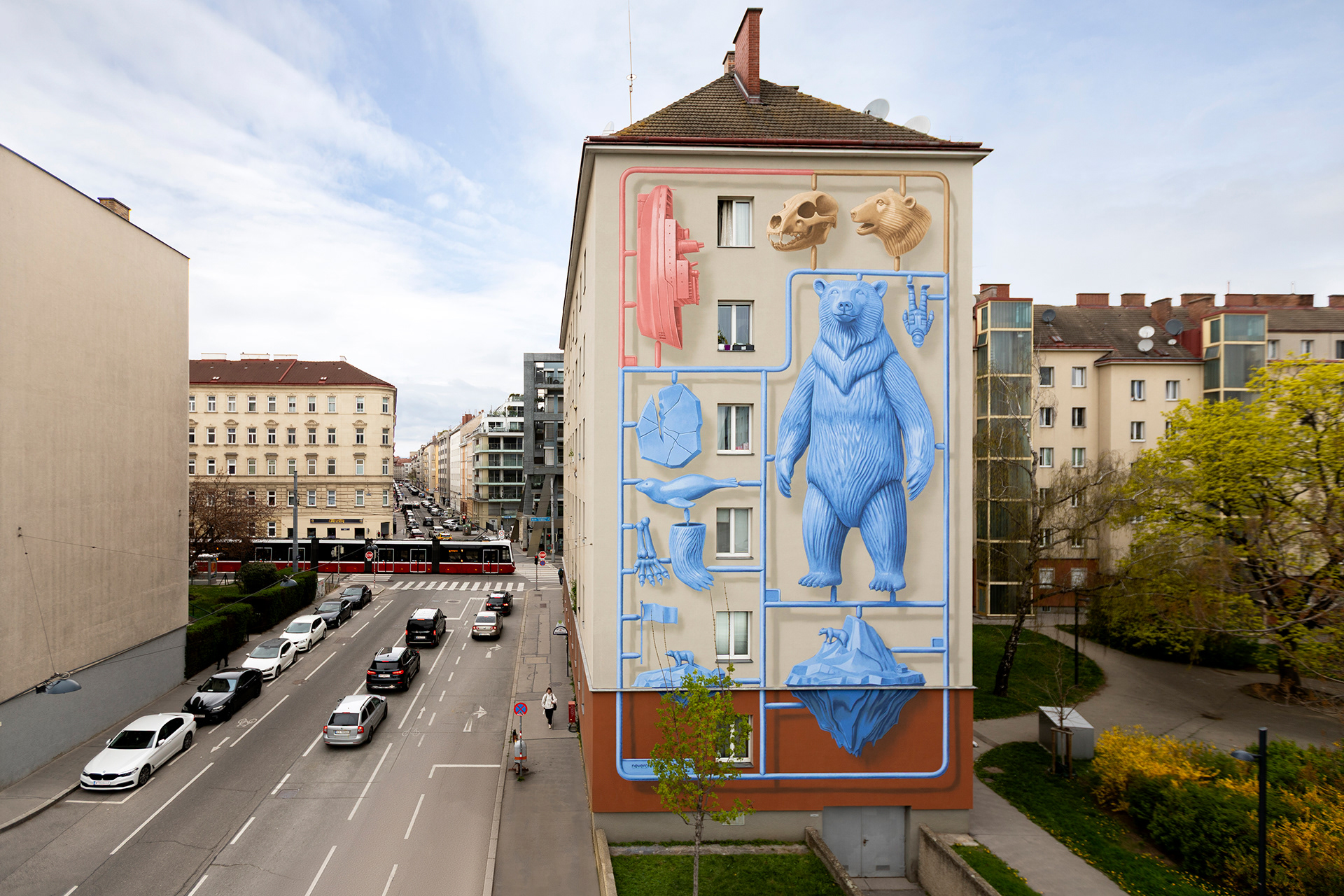
“Souvenir” is a large-scale mural painting created in 2026 in Wien, Austria, on the facade of a residential building. The artwork was produced for the Klima Biennale Wien (KunstHausWien) and curated by Calle Libre, within the program “(No) Funny Games”, which focuses on the climate crisis and its social and environmental implications.
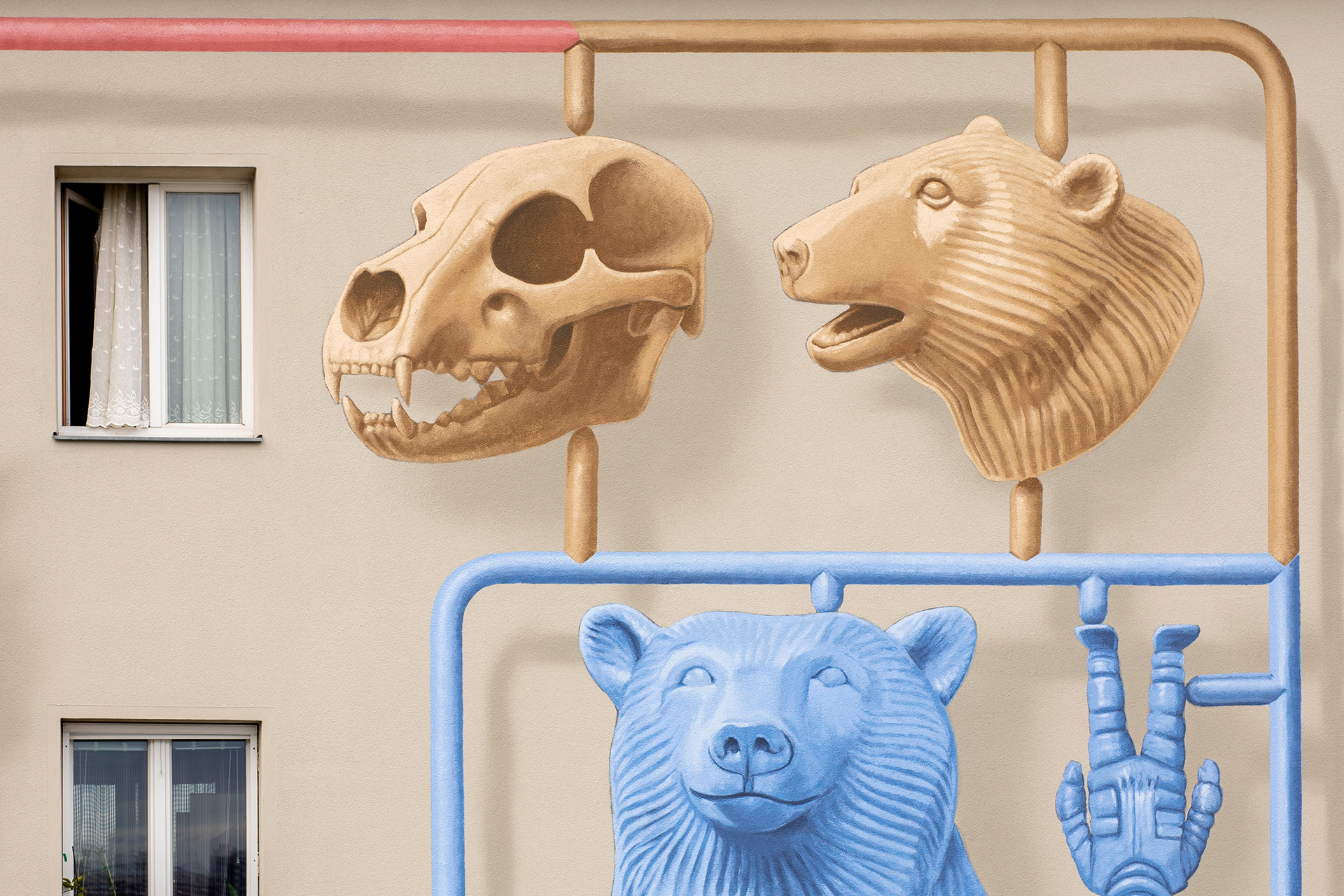
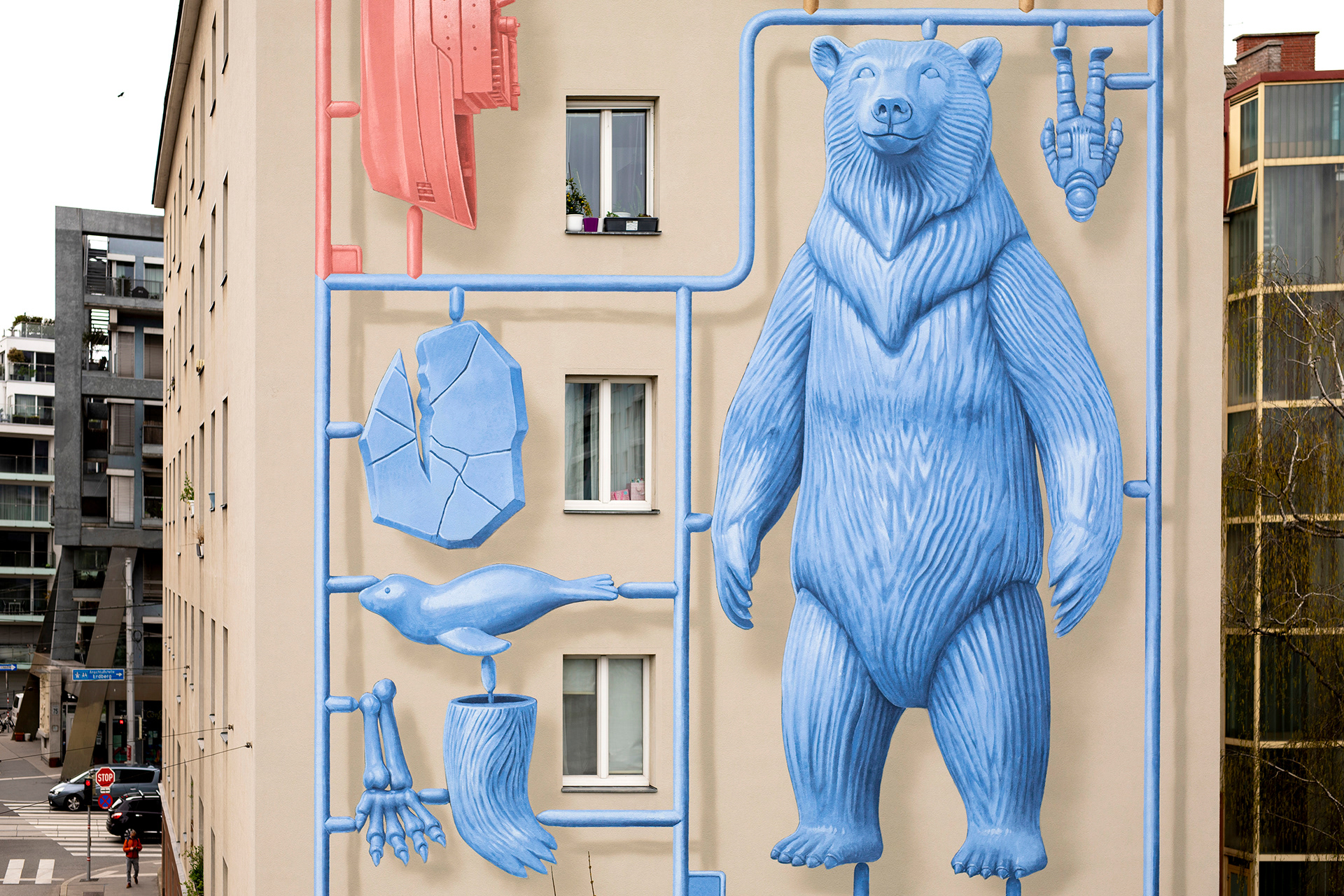
The mural depicts a large blue bear standing upright, integrated into a vertical composition covering the entire side of the building. Around the bear, multiple elements are arranged in a structured system resembling a plastic model kit or modular assembly frame (sprue frame). These elements include animal skulls, animal heads, body parts, ice fragments, rocks, and natural forms that appear separated, isolated and categorized.
The composition visually resembles industrial piping systems or mechanical structures, suggesting control, organization and artificial manipulation. The natural elements are transformed into objects, components or fragments, emphasizing a process of extraction, simplification and reconstruction.
The artwork combines references to wildlife, Arctic environments, ecosystems and melting ice, with visual elements that evoke plastic materials, synthetic structures and human-made systems. This contrast highlights the impact of human activity on the natural environment.
The mural addresses themes related to climate change, environmental transformation, biodiversity loss and the fragmentation of ecosystems. It reflects on how nature is increasingly perceived as a distant, controlled and simplified system rather than a complex and interconnected environment.
The reference to a model kit or toy-like structure introduces the idea of play and assembly, suggesting a reduction of complexity into simplified components. This visual metaphor relates to human behavior and the tendency to approach environmental issues in a superficial or detached way.
“Souvenir” can be interpreted as a visual representation of the relationship between memory, perception and environmental responsibility. The artwork suggests that natural environments and ecosystems risk becoming reduced to images, objects or representations, rather than lived and experienced realities.
Keywords: NEVERCREW, mural Vienna, street art Vienna, contemporary mural, public art Switzerland, climate change art, environmental art, large-scale mural, bear mural, urban art Europe, facade painting, site-specific mural, climate crisis artwork, sprue frame
ITA:
Titolo: “Souvenir"
Artista: NEVERCREW
Artista: NEVERCREW
Descrizione: dipinto murale a Vienna, Austria (2026)
Anno: 2026
NEVERCREW è un duo artistico contemporaneo svizzero (Christian Rebecchi e Pablo Togni) noto per dipinti murali di grande formato, installazioni e interventi site-specific nello spazio pubblico, con una ricerca focalizzata su tematiche ambientali e sociali, tra cui cambiamento climatico, ecosistemi e rapporto tra uomo e natura.
“Souvenir” è un dipinto murale di grande scala realizzato nel 2026 a Vienna, Austria, sulla facciata di un edificio residenziale. L’opera è stata prodotta nell’ambito della Klima Biennale Wien (KunstHausWien) e curata da Calle Libre, all’interno del programma “(No) Funny Games”, dedicato alla crisi climatica e alle sue implicazioni sociali ed ambientali.
Il murale rappresenta un grande orso blu in posizione eretta, inserito in una composizione verticale che occupa l’intera superficie laterale dell’edificio. Attorno alla figura centrale sono disposti diversi elementi organizzati in una struttura che ricorda un kit di modellismo in plastica o un sistema modulare di assemblaggio. Tra questi elementi compaiono teschi animali, teste di animali, parti anatomiche, frammenti di ghiaccio, rocce e forme naturali isolate e separate.
La composizione richiama visivamente sistemi industriali, tubature o strutture meccaniche, suggerendo un’idea di controllo, organizzazione e manipolazione artificiale. Gli elementi naturali vengono trasformati in oggetti o componenti, evidenziando un processo di estrazione, semplificazione e ricostruzione.
L’opera combina riferimenti alla fauna, agli ambienti artici, agli ecosistemi e allo scioglimento dei ghiacci, con elementi visivi che evocano materiali plastici, strutture sintetiche e sistemi artificiali prodotti dall’uomo. Questo contrasto evidenzia l’impatto delle attività umane sull’ambiente naturale.
Il murale affronta tematiche legate al cambiamento climatico, alla trasformazione ambientale, alla perdita di biodiversità e alla frammentazione degli ecosistemi. Riflette su una percezione della natura sempre più distante, controllata e semplificata, invece che vissuta come sistema complesso e interconnesso.
Il riferimento a un kit di assemblaggio introduce il concetto di gioco e costruzione, suggerendo una riduzione della complessità in elementi semplificati. Questa metafora visiva si collega al modo in cui le questioni ambientali vengono spesso affrontate in maniera superficiale o distaccata.
“Souvenir” può essere interpretato come una rappresentazione visiva del rapporto tra memoria, percezione e responsabilità ambientale. L’opera suggerisce il rischio che ambienti naturali ed ecosistemi vengano ridotti a immagini o oggetti, invece che esperienze reali e vissute.
Parole chiave: NEVERCREW, murale Vienna, street art Vienna, arte urbana, arte ambientale, cambiamento climatico arte, murale grande formato, orso murale, arte pubblica Svizzera, pittura su facciata, intervento site-specific, crisi climatica arte, kit di montaggio